


If you’ve ever told yourself “Yeah, but I don’t have the equipment yet” or “I’ll start marketing once everything’s set up,” this episode is a direct punch in the face—in a good way.
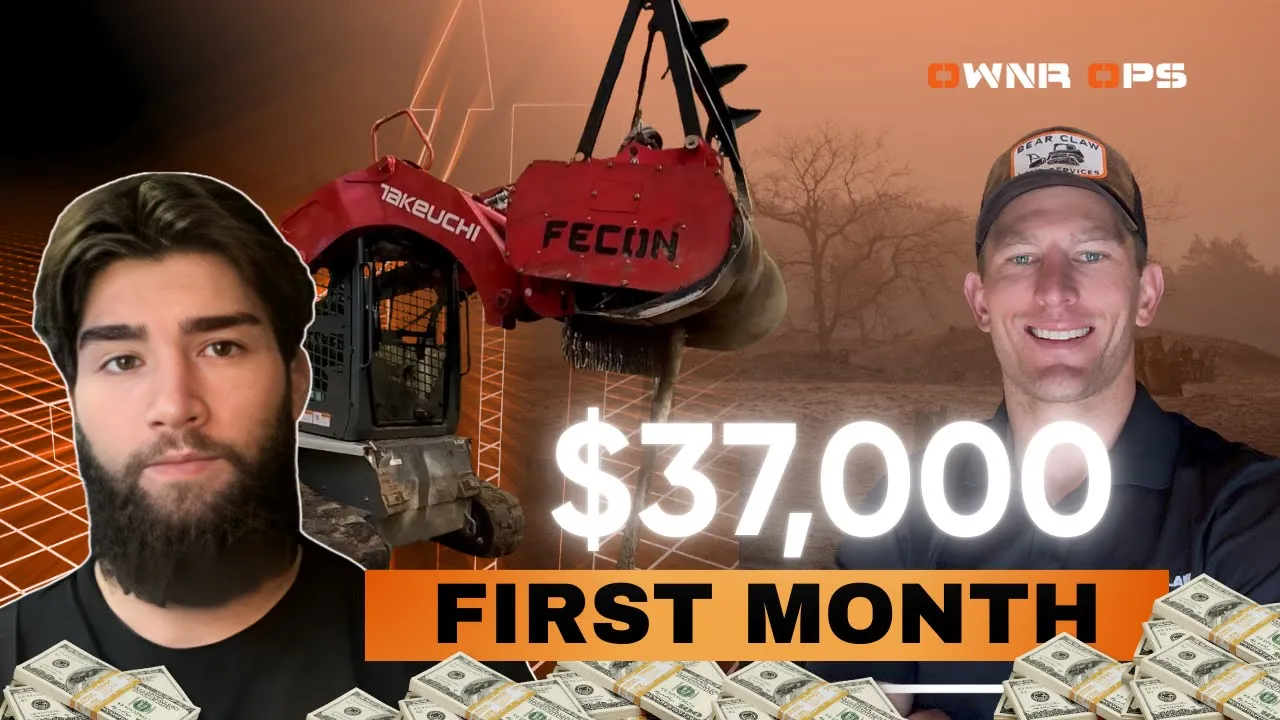
Owen Alexander is 19. He went from stump grinding to land clearing, pre-sold $20,000 of work before he bought his first skid steer, and then produced $37,000 in his first month running land clearing jobs.
Not a theory. Not a long runway. Not a ten-year story. Month one.
This blog post breaks down exactly what he did, why the pivot worked, and the operating principles you can steal—even if you’re starting from scratch.
Owen’s Starting Point: Momentum, Not Perfection
Owen launched stump grinding right after his first year of college. He wanted to take everything he’d been learning “in theory” and actually pressure test it in real life.
It worked—fast. He generated around $20K in his first month stump grinding. But he didn’t treat that as “proof the business is perfect.”
He treated it as proof the engine works… and then started asking a better question:
“What’s the highest-upside vehicle I can attach this engine to?”
That question led to land clearing.
Why He Pivoted From Stump Grinding to Land Clearing
Owen’s pivot wasn’t emotional. It was strategic. Three factors drove it:
1) Market size (ceiling matters)
He did quick “napkin math” on his market (St. Louis). Stump grinding felt capped—he couldn’t find many operators scaling past ~7 figures. Land clearing looked like a much bigger pie (high eight figures locally, in his view).
When you’re building for the long term, ceiling matters.
2) Ticket size (simplicity matters)
Here’s the operational punchline:
- $20K stump grinding = 30–40 customers
- $37K land clearing = 9 customers
That’s the difference between running a customer service call center… and running a high-ticket production business.
Fewer customers = fewer headaches = easier scheduling = easier delivery = faster scale.
3) Paid ads “pencil” better at high ticket
Owen’s entire playbook starts with sales and marketing first. But paid acquisition has to make financial sense.
In stump grinding, if it costs you $100 to acquire a customer and your average ticket is $500, you’re working with a tight margin and you have less room for error.
In land clearing, if it costs $300–$1,500 to acquire a customer but your ticket is $7K–$10K+, the math gets a lot more forgiving—and a lot more scalable.
This is the CAC:LTV reality most contractors never actually write down.
The Most Savage Part: He Ran Ads Before He Had Equipment
While most guys wait until the machine is in the yard, Owen did the opposite:
- He started winding down stump grinding.
- He launched paid ads for land clearing anyway.
- He sold jobs while he was still building the business infrastructure (CDL, sourcing equipment, financing, etc.).
- By the time he completed his first job, he had ~$35K sold.
That meant once the machine showed up, he wasn’t scrambling for work—he was focused on execution and reviews.
That’s the real advantage of pre-selling:
You buy yourself time to deliver well, not just deliver fast.
His Close Process: Speed + Qualification + In-Person Conversion
Owen’s sales process is simple, aggressive, and repeatable.
Step 1: Speed to lead in under 60 seconds
He responds fast—because speed is a weapon.
He’s “off doing something” but still gets back to leads immediately.
Step 2: Lead with an open-ended question
He starts with:
“Tell me about your project.”
That gets the customer talking (and revealing everything you need to qualify and frame the close).
Step 3: Qualify hard (and set a minimum)
He recently raised his minimum to $2,500 and makes sure the lead clears the minimum over the phone.
This prevents low-value jobs from stealing bandwidth.
Step 4: Convert to an in-person site visit
Even if they ask for price over the phone, he finds a reason to move it to an in-person visit because his close rate is higher in person.
Step 5: Use a professional site-visit checklist
He literally shows up with:
- boots + clean appearance
- a printed form on a metal clipboard
- a “risk assessment checklist” (septic, well heads, fence lines, access points, staging, etc.)
The checklist isn’t just operational—it’s trust engineering.
Customers don’t always know what matters. When you ask the questions they didn’t know to ask, you become “the pro” instantly.
Step 6: Price in person and close on the spot
Because he’s using a day rate right now, quoting is faster. He aims to give the number in person and close immediately.
The “Scarcity Post” That Got Him Paid to Travel
One of the most practical tactics in the episode: Owen used Facebook Groups to book work when he had a gap.
He had two open days, drove to Columbia, and posted something like:
- a client rescheduled
- he has two days open (specific dates)
- limited availability
- light discount that expires
Outcome:
- 4 jobs
- $9,900
- 100% close rate
- and he essentially got paid to be in that market
This matters because it shows another principle:
Organic distribution + urgency + specific window = instant demand.
And it didn’t take hours. He said the post took ~20 minutes and created almost $10K in booked work.
“Two-Way Door vs One-Way Door” Decision-Making
Owen uses a framework that keeps him moving:
- One-way doors: hard to reverse (major hires, long leases, big fixed commitments)
- Two-way doors: reversible decisions (testing a market, trying an offer, running a new campaign)
Most operators get stuck because they treat everything like a one-way door.
His edge is recognizing when 80% certainty is enough—and moving.
A perfect example: he nearly scrapped his pivot when commercial insurance came back at $2,500/month on a truck.
Instead of freezing, he did the math:
- bought the truck under market
- accepted the high insurance as temporary runway
- planned to optimize later
- and focused on the only real solution: sell more
The Focus Rule: One Service, One ICP, One System
This might be the most valuable operating decision he’s making:
He says no to almost everything.
Even if he can do it (tree climbing, dirt work, dozer work), he’s staying narrow:
- one core service (forestry mulching / land clearing)
- one repeatable delivery method
- one repeatable sales process
- one marketing funnel
Why?
Because specialization compounds:
- faster training
- cleaner ops
- tighter messaging
- easier delegation
- higher close rates (“this is all we do” is persuasive)
In his current market (Columbia), he’s seeing a big gap: zero specialized land clearing companies, which makes that positioning even stronger.
The 2026 Goal: $1M (and the org chart to get there)
Owen’s “safe” public goal is $500K in 2026, but he’s flirting with $1M because the model is straightforward:
Step 1: Overseas admin hire (next ~2 months)
He’s getting home late with 50 emails and CRM tasks stacked up. An admin hire is his first step into delegation with lower operational risk.
Step 2: Add capacity (second machine + field hire)
He estimates a productive machine can do $500K–$600K/year in his market. So:
- 2 machines + 2 operators = ~$1M potential
- Owen stays focused on sales/marketing and keeps the pipeline full
He also points out something smart: adding a second machine makes fixed overhead (like vehicle costs) make more sense because revenue scales faster than those costs.
The Real Lesson: “If He Can Do It, Why Can’t You?”
Owen isn’t winning because he has some secret hack.
He’s winning because he does a few boring things extremely well:
- start marketing before you feel ready
- respond immediately
- qualify hard
- sell in person
- pre-sell to remove pressure
- keep the service narrow
- make decisions fast with imperfect info
- fix problems by generating more leads and selling more
And he’s doing it at 19.
Which makes the closing question unavoidable:
If Owen can build a land clearing business from zero to $37,000 in month one…
what excuse are you still holding onto?
Don’t just read the summary—hear the full strategy straight from Owen. Watch the full episode on how he hit $37K in month one on YouTube, Spotify and Apple Podcasts
If you’re serious about growing your land clearing services, come hang out with us inside the free OWNR OPS Skool group. We share the systems, scripts, and frameworks we’re using to generate leads, close bigger tickets, and run smoother ops: https://www.skool.com/ownrops
Also—get the weekly breakdown of strategies and business tips by subscribing to the OWNR OPS newsletter: https://www.ownrops.com/newsletter


